What Types of Engine Additives Are There and How Do They Work?
There are dozens of different engine additives on the market. Despite similar promises from manufacturers, they solve completely different problems. Some reduce friction, others protect components from wear, others act on engine seals, and some use outdated technologies that the modern industry has already abandoned.
The word "additive" says nothing about its mechanism of action. Before assessing how effective a specific product is, it helps to understand which fundamentally different chemical category it belongs to.
Wear protection
Anti-wear additives work at the moments when the oil film becomes too thin to fully separate surfaces, most often under boundary lubrication during cold starts or in zones of high point loads. Their job is to form a chemically bonded protective layer on the metal that takes the load instead of the metal itself.
| Additive type | How it works |
|---|---|
| ZDDP (zinc dialkyldithiophosphate) | A classic anti-wear component, used in engine oils for decades. Forms a sacrificial film on the metal, usually 50-150 nanometres thick. |
| Borate esters | An ash-free alternative to ZDDP, containing no sulphur or phosphorus. Forms a protective layer on the metal surface under friction and heat. |
| Modern ash-free AW additives | A group of compounds based on fatty acid amides, esters, and nitrogen-containing components, developed to replace zinc and phosphorus. |
The reason the industry is actively developing ash-free alternatives to ZDDP isn't that zinc and phosphorus protect metal poorly, they do the job excellently. The problem is that the ash produced when ZDDP burns ends up in the exhaust after-treatment system and can gradually reduce catalytic converter efficiency. Borate esters and other ash-free AW components address exactly this issue, leaving no ash in the combustion products. That said, borate esters have their own weak point: they're sensitive to hydrolysis, meaning they can react with water to form insoluble boric acid, which under certain conditions can cause corrosion.
Friction reduction
Unlike anti-wear components, friction modifiers don't so much protect metal from contact as reduce the sliding resistance itself. Most solid friction modifiers have a layered crystal structure: individual atomic layers are held together by weak forces and easily shift relative to each other, producing low friction.
| Component | Notable feature |
|---|---|
| Molybdenum disulphide (MoS2) | A classic solid friction modifier. Modern engine oils more often use not MoS2 itself, but an oil-soluble organomolybdenum compound (MoDTC), which disperses evenly in the oil rather than settling as particles. |
| Tungsten disulphide (WS2) | A layered structure similar to MoS2, but with an even lower coefficient of friction, one of the lowest among solid friction modifiers. |
| Boron nitride (BN) | A hexagonal crystal structure, similar in principle to graphite, but with greater chemical inertness and stability at high temperatures. |
| Graphite | One of the earliest solid friction modifiers used, a layered carbon structure. Requires a certain level of moisture or volatile components to work reliably. |
Protective coatings
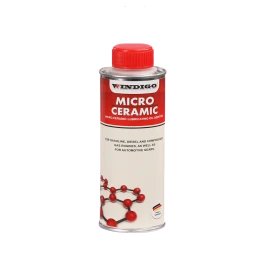
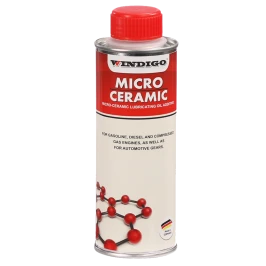
Additives that manufacturers call "ceramic" or "metal-ceramic" form a hard protective layer on engine component surfaces based on inorganic compounds, such as metal oxides or nitrides. Unlike ZDDP or molybdenum friction modifiers, which act mainly in zones of boundary lubrication, a ceramic coating gradually builds up on the metal surface and can remain there for some time even after an oil change.
One mechanism of action claimed by some manufacturers is that part of the ceramic microparticles fills in the roughness of the metal surface, while another part stays suspended in the oil. In this case, the sliding surfaces interact not directly metal-to-metal, but through a layer of ceramic particles, which manufacturers link to reduced noise and vibration.
Outdated technology: chlorinated paraffins
The best-known chlorine-containing anti-wear components of the past were chlorinated paraffins. Despite their high effectiveness under extreme loads, their use came with a serious drawback. At high temperatures and during tribochemical reactions, they decomposed to release hydrogen chloride (HCl). In the presence of moisture, HCl forms hydrochloric acid, which is highly corrosive.
Hydrogen chloride forms as a result of tribochemical reactions and the high temperatures typical of a running engine, not from simply storing the oil. Combined with the moisture inevitably present in the lubrication system, this creates hydrochloric acid, which gradually corrodes metal surfaces from within.
This is exactly why additive manufacturers moved completely to chlorine-free anti-wear technologies for engine oils: the corrosive nature of chlorinated paraffins makes them poorly suited to internal combustion specifically. At the same time, in other fields, such as metalworking fluids for drawing and extruding metal, chlorinated paraffins are still used today, since there the corrosion risk is less critical and alternatives are noticeably more expensive. In the EU, a phased withdrawal of medium-chain chlorinated paraffins from such industrial fluids is only being discussed now, with a tentative target of 2036, meaning the industry hasn't fully parted with this chemistry, it has simply displaced it from engine oils rather than from every field of use.
Common misconceptions
All engine additives work on the same principle.
No. Anti-wear components protect metal from direct contact, friction modifiers reduce the sliding resistance itself, and some products address completely different tasks, such as acting on seals. These are fundamentally different mechanisms.
Molybdenum in an additive is always the same substance.
No. Solid powdered molybdenum disulphide (MoS2) and the oil-soluble organomolybdenum compound (MoDTC) used in most modern engine oils behave completely differently in oil.
An ash-free additive is inherently worse at protecting than ZDDP.
No. Ash-free components like borate esters weren't developed because ZDDP protects metal poorly, but because the ash from ZDDP gradually reduces catalytic converter efficiency. The purpose of these additives is to solve the catalyst compatibility problem, not to make up for weak protection.
Frequently asked questions
- Why did the industry start moving away from ZDDP at all, if it works well?
- It's not about ZDDP's protective properties, but about the ash produced when it burns, which gradually reduces exhaust catalytic converter efficiency, which is why modern requirements are pushing toward ash-free alternatives.
- Can a modern ash-free additive fully replace ZDDP?
- In many modern oils, ash-free components are used alongside a reduced amount of ZDDP rather than as a full replacement for it, since the final balance of protection and catalyst compatibility is achieved precisely through the combination of additives.
- Why does tungsten disulphide have lower friction than molybdenum disulphide?
- Both substances have a similar layered crystal structure, but tungsten has weaker interlayer interaction, which gives a lower coefficient of friction under comparable load conditions.
- Are chlorinated paraffins dangerous if they've already made it into the oil?
- The corrosion risk is specifically tied to the breakdown of these compounds at high temperatures and through tribochemical reactions while the engine is running, so the problem is relevant during active use, not simply while the oil sits in storage.
Conclusion
Engine additives share only a common name, not a common mechanism of action. Anti-wear components like ZDDP and borate esters protect metal from direct contact, friction modifiers based on molybdenum, tungsten, boron, or graphite reduce the sliding resistance itself, and ceramic coatings form their own protective layer on component surfaces. The history of chlorinated paraffins, in turn, shows that even a technically effective solution can be displaced from a particular field of use if it creates risks that outweigh its benefits.